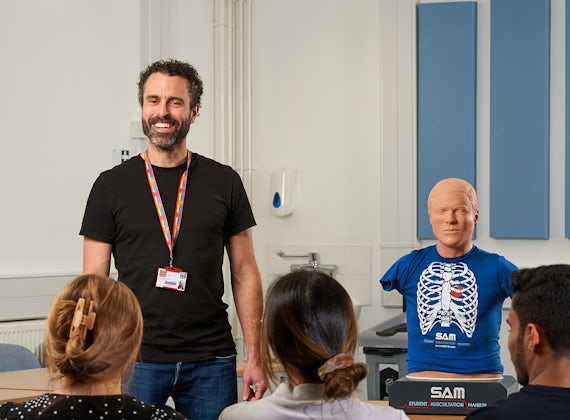
Dr Chris Allender
General
A member of the School's Drug Delivery & Microbiology Research Discipline
Coordinator of the Molecular Recognition Research Group.
Much of our work sits at interfaces between scientific disciplines, we positively encourage inter- and cross- disciplinary research.
Research Interests
Synthetic Molecular Recognition
A major focus of our laboratories is the design, characterisation and optimisation of synthetic materials that mimic the selective molecular binding properties of biological macromolecules. Templating processes such as molecular imprinting are used to prepare polymeric supports that posses ‘antibody’ like affinity and selectivity for particular target molecules. We are interested in designing new materials and in modifying and optimising existing approaches.
Current Projects:
- Developing a synthetic receptor capable of distinguishing between the active and the inactive forms of prion protein.
- Bacterial biosensing: a LPS sensitive device
- Phage display generated peptides selective for low molecular weight targets
- Optimisation of precipitation approaches for preparing nano- and micro- imprinted spheres
Microfabrication and microfluidics
The elegance, convenience and effectiveness of micro- and nano- fabricated systems translate seamlessly into the world of chemical, synthesis, separation, analysis and sensing. We are currently particularly interested in blurring the boundaries between the worlds of synthetic molecular recognition materials, microfabrication and microfluidics.
Current Projects:
- Multiphasic, segmented flow, selective chemical enrichment and separation
- Molecular gradients: nano patterning
- RF sensing and molecular imprinting
- Catalytic molecularly imprinted microgels for ‘on-chip’ flow-through micro reactors
- Microfabricated single cell ‘wells’ for manipulation and observation of non-adherent cells.
- Multiphase microfluidic devices for chemical synthesis and purification
Drug Delivery
Designing systems capable of delivering macromolecules across the skin is particularly challenging. We use microfabricated slicon and polymeric microneedles to breach the stratum corneum barrier in order to deliver macromolecules and particles to underlying viable tissues. We are also interested in feedback responsive intelligent drug delivery and use intelligent ‘synthetic receptors’ to bring about feedback controlled release.
Current Projects:
- Microneedle mediated epidermal vaccination
- Design and preparation of polymeric microneedle arrays for drug delivery applications
Collaborators
School of Pharmacy and Pharmaceutical Sciences
Dr Mark Gumbleton
Dr James Birchall
Dr Keith Brain
Dr Arwyn Jones
Dr Stephen Denyer
Dr Jean-Yves Maillard
Cardiff University
Professor David Barrow, ENGIN
Professor Thomas Wirth, CHEMY
Professor Adrian Porch, ENGIN
Dr Phil Davies, CHEMY
External
Dr Cameron Alexander, Nottingham University, UK
Professor Zhongwei Gu, Sichuan University, China
Dr Anthony Morrissey, Tyndal Institute, Cork, Ireland
Dr Peter McCloughlin, WIT, Ireland
Professor Ian Nicholls, Kalmar, Sweden
Dr Sergey Piletsky, Cranfield University, UK
Dr Dan Rathbone, Aston University, UK
Dr Mike Whitcombe, Cranfield University, UK
Current Research Funding
EPSRC (DTA) £84K
EU INTERREG IIIA £287K
RPSGB £56K