Genetics

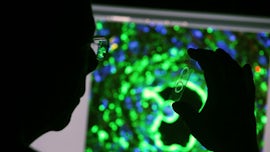
Embryonic stem (ES) cells growing in culture.
The Genetics group is comprised of 11 staff members, who share an interest in the role of genetics in development and disease. Principally this is addressed by analysing phenotype- genotype relationships in a diverse set of organisms including Drosophila melanogaster, Xenopus and the Mus Musculus.
Professor Martin Evans' group centres on the use of embryonic stem (ES cells, pictured right) cell-based transgenic technologies to study mammalian gene function, with a particular focus on the analysis of gene dysregulation during development and disease. The principal interests of his group are in: the development of new methodologies to enhance transgenesis. This goal is being pursued both through the development of SiRNA technology and through the development of transgenic 'libraries' of mutant alleles using gene trap technology.

Cell death scored by caspase 3 cleavage in the intestine.
Professor Alan Clarke’s group uses similar technology to investigate the role of both epigenetics and genetics in determining cancer predisposition and the response to cancer therapy. This is achieved through both conventional transgenesis and conditional (switchable) transgenesis. In particular, this group analyses the in vivo role of a range of different tumour suppressor genes in determining the predisposition to cell death, the response to DNA damage, the mutation burden, genomic stability and the predisposition to neoplasia.
Prof Vladimir Buchman’s current research is focused on functional studies of protein families which members are involved in cell signalling and development of the nervous system. We also try to reveal connections between dysfunction of these proteins and development of human pathologies, first of all neurodegenerative diseases. A wide range of techniques, from molecular biology and tissue culture methods to transgenic and knock-out technologies, and even behavioural studies are used to address these questions.

Non-cell autonomous induction of muscle (purple) by constitutive-active Nodal/Activin receptor Alk4 (red) in Xenopus ectodermal explants.
Dr Branko Latinkic’s group is on cell fate determination, or how initially indifferent embryonic cells decide to adopt their final fate. What determines that some seemingly identical cells of the early embryo become neurons, and others heart muscle or skin? We study these questions in the context of early development of heart and liver in Xenopus embryos.
Dr Mike Taylor’s laboratory is focussed on how cells become different from each other and develop into specialised tissues. Such cell differentiation studies inform both stem cell and cancer biology. Mike’s group works with the fruit fly Drosophila melanogaster, a model organism that historically has shaped our understanding of many aspects of biology. For today’s influence, it is striking that there are similar genes in Drosophila for nearly 80% of human “disease genes”.
Dr Nick Allen’s laboratory are to investigate the mechanisms of neural differentiation of human and mouse embryonic stem cells, and to develop protocols to direct the differentiation of neural progenitors to acquire specific neural fates and phenotypes. ES cells are pluripotent, however Dr Allen has shown that in chemically defined media differentiation is restricted towards the neural lineage. ES cell differentiation generates naïve neural progenitors and these are highly responsive to extrinsic developmental patterning cues such as growth factors and morphogens which can be used to direct their differentiation to acquire specific neural identities. Therefore specific cell types can be derived by a process of applied developmental biology.

Drosophila muscles.
In mammals, some genes, although they are present in two copies, are expressed from only one allele – a phenomenon termed Genomic Imprinting. Dr Rosalind John’s group is using BAC transgenes to study the consequences of excess expression of three of these genes. The groups work also aims to elucidate how epigenetic processes interact to achieve heritable gene silencing using modified BAC transgenes to identify imprint control regions (ICRs) that regulate allele specific expression.
The principal interest of Dr Richard Clarkson’s group is the study of cell death with particular reference to the genetic programmes that control the removal of supernumerary cells from the mammary gland, a process essential for tissue homeostasis during mammary development and for preventing the progression of breast cancer. The group uses a combination of cell culture and transgenic approaches to conditionally manipulate cell death (apoptosis)-related genes both in normal mammary tissues and in models of breast cancer.
Dr Nick Kent is interested in the structure and function of chromatin, the complex of DNA and protein which makes up the chromosomes of humans and other eukaryotes. The fundamental repeating units of chromatin are nucleosomes: octameric protein ‘cotton reels’ wrapped by approximately two turns of DNA. Transcription of genes, DNA replication and DNA repair all require enzymes which act to modulate nucleosome structure or position. The Kent lab uses budding yeast as a model system to study these chromatin-remodelling factors with the aim of understanding deficiencies in human remodelling which are implicated in a number of disease processes including cancer. We are also currently developing nucleosome position analysis methods in higher eukaryotic models.
Establishment and maintenance of cell polarity is a fundamental feature of most eukaryotic cells which underlies essential cellular and developmental processes. Dr Sonia Lopez de Quinto is interested in understanding how local translation of asymmetrically enriched mRNAs contributes to cell polarization. Her lab uses Drosophila melanogaster as a model system for the identification of localized mRNAs sharing similar regulatory proteins. Comparative analysis of the post-transcriptional regulation of such mRNAs will allow the characterization of common cis-regulatory motifs and associated proteins, which ultimately coordinate the temporal and spatial regulation of localized mRNAs.
Dr Helen White-Cooper's research is focussed on changes in gene expression patterns as cells progress through differentiation. Mature motile sperm have a highly specialised cellular architecture, and their differentiation involves changes in expression of many genes, including the activation of >1000 testis specific genes. Helen's group investigates the transcriptional control complexes that regulate the timing of transcription in male germ-line cells, using Drosophila as a genetically tractable model system. Spermatogenesis in flies and vertebrates also relies on post-transcriptional regulation, and we are investigating mRNA localisation and translational repression in developing spermatids.
Dr Henrietta Standley's research aims to understand how maternally supplied factors and embryonic signalling molecules establish the embryonic body plan during early development, using the frog Xenopus laevis as a model system.
Dr Catherine Boulter’s group is studying the function of genes involved in regulating stem/progenitor cells in mammalian organogenesis and determining how these developmental mechanisms underpin tissue regeneration and disease. Molecular, cell culture and transgenic/knockout technologies are used to investigate the role of these genes in regulating stem/progenitor cell proliferation, survival and differentiation in response to signals from the extracellular environment.